
Salesforce Ben's AppAssessor review of Distribution Engine - check it out now!
Test it for free for 30 days or get in touch if you’d prefer to chat.
Fancy giving Distribution Engine a try?
Have a play around for free, or get in touch if you’d prefer to chat.
Lead Routing for Multi-Product Salesforce Orgs: How to Assign Leads Across Teams.
Key takeaways:
Multi-Product Routing Is Multi-Dimensional: When leads can be interested in more than one product, routing logic needs to evaluate product interest alongside geography, account ownership, skills, and capacity - simultaneously, not sequentially.
Native Assignment Rules Break at Scale: Salesforce's sequential rule evaluation can't handle the combinatorial complexity of multiple product lines, territories, and team structures. Multi-product orgs outgrow native rules faster than anyone expects.
Skills-Based Routing Is the Answer to Product Complexity: Tagging reps by product certification, language, or vertical expertise - then matching leads to those tags automatically - replaces the spaghetti of product-specific assignment rules
Cross-Sell Leads Need Different Logic: A lead from an existing customer interested in a different product shouldn't enter the standard routing flow. It should reach the team that sells that product while the account owner retains visibility.
One Org, Multiple Routing Workflows: Multi-product orgs need parallel routing paths within a single Salesforce instance - different distribution logic for each product line, unified by shared territory and account ownership rules.
Distribution Engine Handles the Complexity Natively: NC Squared's Distribution Engine supports multiple concurrent distribution workflows, skills-based routing via Tags, product-line segmentation, and cross-object routing - all inside a single Salesforce org without custom code.
You sell three products. You've got separate sales teams for each. They share the same Salesforce instance, the same account database, and the same lead capture forms.
A lead comes in from a webinar about Product A. Simple enough - route it to the Product A team. But wait. The lead's company is already a customer of Product B. The account owner is on the Product B team. Do they get the lead? Does the Product A team get it? Does someone need to manually figure this out every time?
Now multiply that by 200 leads per week. Add a fourth product line launching next quarter. Include a team restructure that moved three reps from Product B to Product C. And remember that your Salesforce assignment rules were built two years ago when you sold two products.
This is the reality of lead routing in multi-product Salesforce organisations. The complexity doesn't grow linearly - it compounds. Every additional product line, team boundary, and cross-sell scenario multiplies the routing logic required. And at some point - usually sooner than expected - native Salesforce assignment rules can't keep up.
This guide covers how to architect lead routing for multi-product orgs: handling product-based segmentation, skills-based assignment, cross-sell scenarios, and team coordination within a single Salesforce instance.
Why Multi-Product Routing Is Fundamentally Harder.
Single-product lead routing is essentially a one-dimensional problem: which rep should work this lead? The variables are geography, capacity, availability, and maybe account ownership. The logic is linear.
Multi-product routing adds a second dimension: which team should work this lead? And that dimension interacts with every other variable in non-obvious ways.
Product interest determines team assignment. A lead interested in your enterprise platform goes to Team A. A lead interested in your SMB product goes to Team B. But the criteria for identifying product interest aren't always clean - a lead from a webinar might express interest in both. A lead from a generic search ad might not express interest in any specific product.
Account ownership spans products. Your biggest customer uses Product A and is now evaluating Product B. The Product A account owner has the relationship. The Product B team has the expertise. Who gets the lead? This question has a different answer in every organisation, and your routing system needs to support whatever answer you choose.
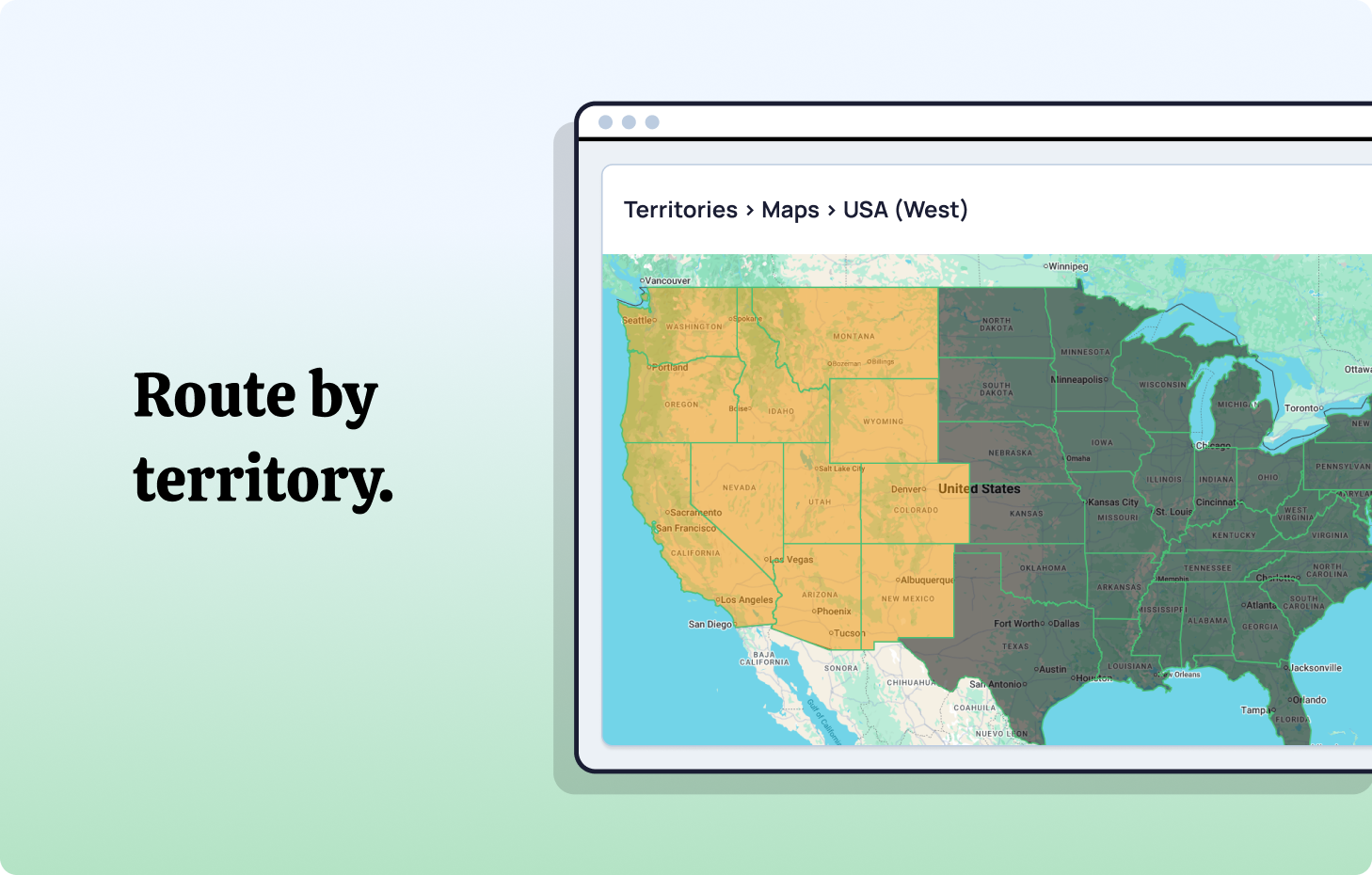
Territories overlap across product lines. Product A's West Coast rep and Product B's West Coast rep cover the same geography but sell different things. A lead from California interested in Product B needs to reach the Product B West Coast rep - not the Product A rep who happens to be tagged to the same territory.
Capacity is product-specific. Your Product A team might be at capacity while Product B has open bandwidth. Global round-robin across both teams doesn't work because the leads require different expertise. Product-specific capacity management is essential.
These interactions are why adding more assignment rules doesn't solve multi-product routing. You end up with a combinatorial explosion of rule entries - Product A × West Coast × Enterprise Tier, Product A × West Coast × Mid-Market, Product A × East Coast × Enterprise Tier... and on it goes. By the time you've covered every combination, you have dozens or hundreds of rules that nobody can maintain, debug, or audit.
Why Native Salesforce Assignment Rules Fail at Scale.
This is worth addressing directly, because it's a question RevOps teams consistently ask: why do Salesforce native lead assignment rules fail at scale?
The answer is architectural. Native assignment rules have three structural limitations that become deal-breakers for multi-product orgs:
Sequential evaluation. Salesforce evaluates assignment rule entries from top to bottom and assigns the lead to the first match. In a multi-product org, this means rule ordering becomes critical - and fragile. Move one rule entry and the entire distribution pattern shifts. Add a new product line and you need to interleave entries throughout the existing list without breaking what's already working.
No workload awareness. Assignment rules don't know if a rep is at capacity, on PTO, or has twenty leads already in "New" status. They match criteria and assign - regardless of whether the rep can actually work the lead. For multi-product orgs where team sizes vary across product lines, this creates structural imbalance.
Static logic in a dynamic environment. When your team structure changes - and in multi-product orgs, it changes frequently - every affected rule entry needs manual updating. Reps move between product teams. New hires join with different product certifications. Territory boundaries shift. Each change requires an admin to navigate Setup, find the right rule entries, and update them without breaking adjacent logic.
These limitations are manageable when you sell one product to one market through one team. They're unworkable when you sell multiple products across multiple teams with overlapping territories and cross-sell requirements.
This is exactly why tools like Distribution Engine exist. They replace sequential rule evaluation with dimensional routing logic - evaluating product interest, territory, skills, capacity, and availability simultaneously rather than cascading through a list of if-then conditions.
Architecting Multi-Product Lead Routing.
Effective lead routing for multi-product orgs requires three architectural decisions made before any configuration begins.
Decision 1: How Do You Identify Product Interest?
Before you can route a lead to the right product team, you need to know which product they're interested in. This seems obvious, but it's where most implementations stumble.
Explicit product interest. The cleanest approach: the lead capture form includes a product interest field. "Which product are you interested in?" with defined picklist values. This gives your routing engine a clean signal to act on.
Inferred product interest. Many leads arrive without explicit product indication. They came from a blog post, a generic search ad, or a brand-level campaign. In these cases, product interest needs to be inferred from other signals: the page they visited, the content they downloaded, the webinar topic, or the UTM parameters on the URL.
Multiple product interest. Some leads are interested in more than one product - or they're not sure which product fits their needs. Your routing logic needs a strategy for these: route to a general qualification team, route to the primary product team based on a scoring hierarchy, or route to the product team most likely to convert based on firmographic data.
Unknown product interest. When product interest genuinely can't be determined, you need a default path. A triage queue, a general SDR team, or a round-robin across product teams are all viable options. What's not viable is letting the lead hit a default owner and hoping someone figures it out.
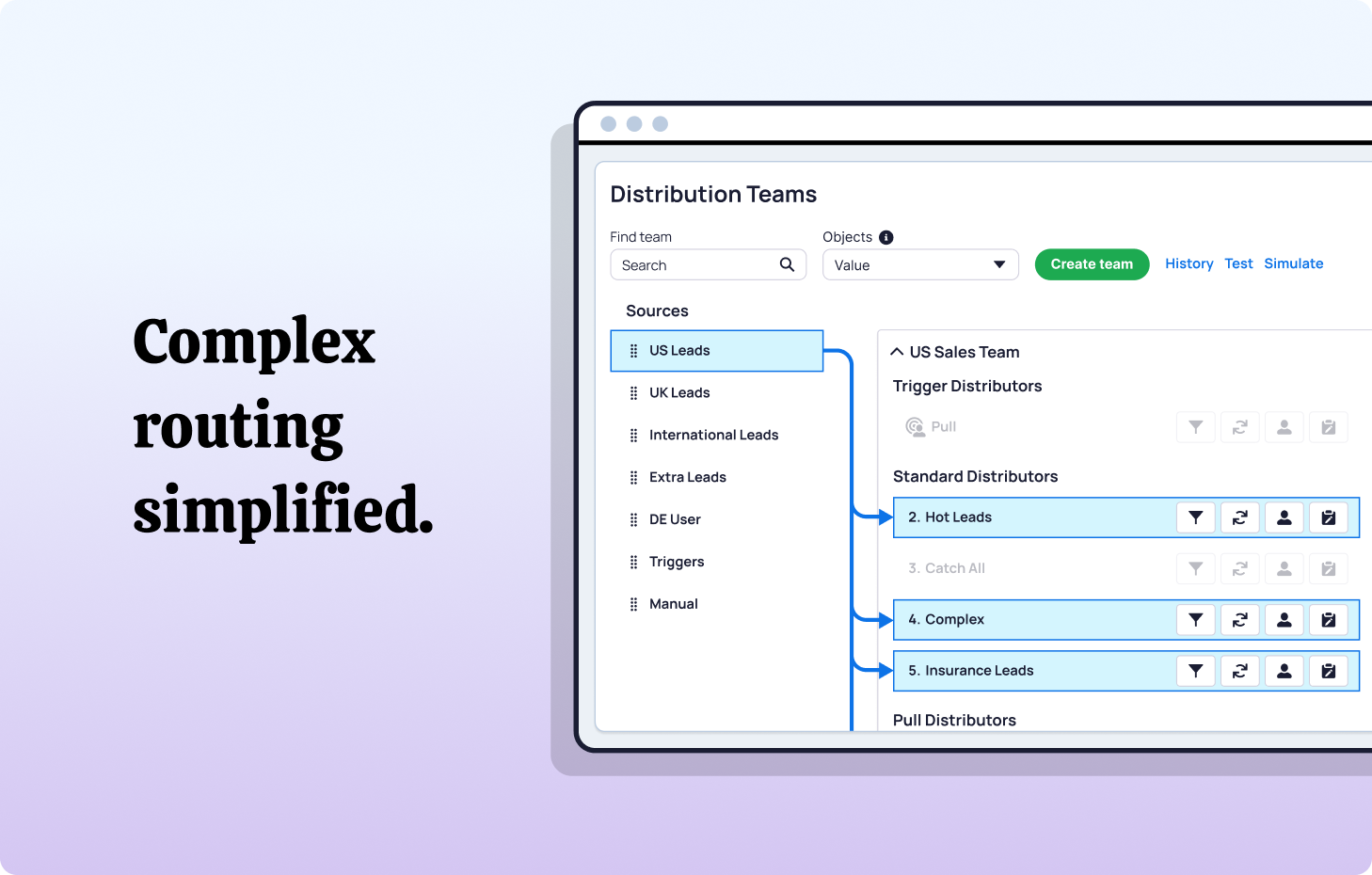
Distribution Engine handles all four scenarios through its multi-distributor architecture. Each product line can have its own distribution workflow with independent rules, while a classifier layer evaluates product interest signals and routes the lead to the correct workflow before distribution occurs.
Decision 2: Shared Org or Shared Everything?
Multi-product organisations typically share a single Salesforce org but may share very little else. The routing architecture needs to respect these boundaries:
Shared accounts. Do product teams share the same account records? If Company X is a customer of Product A and a prospect for Product B, both teams need visibility into the account - but they need separate ownership or opportunity structures.
Separate queues. Each product team should have its own lead queues, its own distribution logic, and its own SLA definitions. What constitutes a fast response for a high-velocity SMB product might be very different from what's expected for an enterprise platform with a six-month sales cycle.
Unified reporting. While routing logic is product-specific, reporting should span the full organisation. Leadership needs to see total lead volume, conversion rates, and pipeline health across all products - not just within individual silos.
Decision 3: How Do Cross-Sell Leads Flow?
Cross-sell routing is the hardest problem in multi-product lead management. A lead from an existing customer interested in a different product line creates a routing conflict: the account team has the relationship; the product team has the expertise.
There are three common models:
Product team owns the lead. The lead routes to the product team that sells what the lead is interested in. The account owner gets notified but doesn't own the lead. This prioritises product expertise over relationship continuity.
Account team owns the lead. The lead routes to the existing account owner, who either works it themselves or facilitates an introduction to the product team. This prioritises relationship continuity over product expertise.
Dual routing. The lead routes to the product team for working, but the account owner is added as a collaborator - with visibility into the opportunity and the ability to engage. This is the most complex model but often the most effective for enterprise organisations.
Distribution Engine supports all three models. Lead-to-account matching identifies the existing customer relationship at the point of lead creation. Based on the match result and the product interest signal, the routing engine applies the appropriate model - sending the lead to the product team, the account owner, or both.
Skills-Based Routing: The Answer to Product Complexity.
For multi-product orgs, skills-based routing is the single most important routing capability after basic assignment. It replaces product-specific assignment rules with a flexible tagging system that connects leads to reps based on capabilities rather than rigid rule entries.
How It Works.
Instead of building separate assignment rules for every product-territory-tier combination, you tag reps with their skills:
Product certifications. Rep A is certified on Products A and C. Rep B is certified on Products B and C. When a Product C lead arrives, both reps are eligible - and the routing engine distributes between them based on capacity, territory, or round-robin.
Language skills. A lead from a French-speaking prospect should reach a French-speaking rep. Tagging language skills and matching them against lead attributes is more scalable than building language-specific rule entries.
Industry expertise. If your Product A team includes reps who specialise in financial services, healthcare, and technology, skill tags ensure that a healthcare lead reaches the healthcare specialist - without needing a separate assignment rule for every industry.
Tier specialisation. Enterprise reps, mid-market reps, and SMB reps handle leads differently. Skill tags for account tier ensure the right seniority of rep engages each lead.
Why This Scales.
The beauty of skills-based routing is that it's additive, not multiplicative. Adding a new product line means adding a new tag - not rewriting your assignment rules. Moving a rep from one product team to another means changing their tags - not finding and updating every rule entry that referenced them.
Distribution Engine implements skills-based routing through its Tags system. Reps are tagged with any combination of skills - product, language, territory, tier - and the routing engine matches incoming leads to reps based on tag criteria. Tags can be weighted (more experienced reps get higher priority) and combined with capacity limits, availability awareness, and round-robin distribution.
Shutterstock uses exactly this approach - managing multi-language, skill-based routing across 20 countries through Distribution Engine's tag system, saving 60 hours per week in manual routing work.
Building the Multi-Product Routing Workflow.
Here's what the complete workflow looks like for a multi-product Salesforce org.
1. Lead enters Salesforce.
Source tagging identifies the origin - web form, campaign, import, outbound. Product interest is captured (explicit or inferred).
2. Classifier evaluates the lead.
Lead-to-account matching checks against existing accounts. Territory Classifier normalises geographic data. Product interest is validated and enriched.
3. Routing decision tree executes.
Is this a cross-sell lead? (Matched to an existing customer account using a different product.) If yes → apply cross-sell routing model (product team, account team, or dual).
Is product interest clear? If yes → route to the product-specific distribution workflow. If no → route to triage or general qualification.
4. Product-specific distribution.
Within the product team's workflow, the lead is distributed based on:
- Territory assignment
- Skills-based matching (product certification + language + vertical)
- Capacity and availability
- Round-robin or weighted distribution
5. SLA enforcement.
Product-specific SLA timers start. If the lead isn't worked within the threshold, automatic reassignment routes it to the next eligible rep within the same product team.
6. Handoff (if applicable).
For leads that require an SDR-to-AE handoff, the routing engine handles the transition - moving the qualified lead to the appropriate AE within the same product line, based on territory, account ownership, or skills.
This entire workflow runs through Distribution Engine's multi-distributor architecture. Each product line has its own distributor with independent rules and team assignments. The classifier layer sits above all distributors, directing leads to the correct workflow based on product interest and account context.
Handling the Edge Cases.
Multi-product routing is defined by its edge cases. Here's how to handle the most common ones.
Edge Case 1: Lead interested in multiple products.
A lead fills out a form indicating interest in both Product A and Product B. Routing them to just one team means the other team loses visibility.
Solution: Route to the primary product team (based on a scoring hierarchy or revenue potential), and create a task or notification for the secondary product team. Distribution Engine supports this through primary routing with secondary notifications - ensuring one team works the lead while the other stays informed.
Edge Case 2: Rep covers multiple products.
In smaller orgs or during transitions, some reps sell across product lines. They should be eligible for leads from multiple product workflows.
Solution: Tag the rep with multiple product skills. Distribution Engine's tag system allows reps to participate in multiple distributors simultaneously - receiving leads from Product A and Product B based on their tag configuration, with capacity managed across both.
Edge Case 3: Product line launch.
A new product launches and needs its own routing workflow, but the team is initially small - maybe two or three reps.
Solution: Create a new distributor for the product line within Distribution Engine. Tag the initial reps. As the team grows, add reps and adjust capacity thresholds. The existing product routing workflows remain completely unaffected - no need to touch them.
Edge Case 4: Account uses one product; different contact evaluates another.
The company is a Product A customer. A different person from the same company submits a form about Product B. Lead-to-account matching identifies them as an existing customer.
Solution: Apply cross-sell logic. Route to the Product B team (they have the expertise) while notifying the Product A account owner (they have the relationship). The key is that the account match triggers a different routing path than a net-new lead would follow.
Edge Case 5: Unclear product interest from high-value lead.
An enterprise lead comes in through a brand-level campaign with no product indication, but firmographic data suggests they could be a significant opportunity for any product line.
Solution: Route to a general qualification team or triage queue. After qualification determines product fit, the lead re-enters the product-specific routing workflow. Distribution Engine supports multi-stage routing - an initial distribution for qualification, followed by a secondary distribution to the product team based on the qualification outcome.
Lead Routing Best Practices for Multi-Product Orgs.
Keep product routing logic separate from territory logic.
Product segmentation and geographic territory are independent dimensions. Build them separately and combine them at the routing layer rather than creating integrated rules that merge both. This makes each dimension independently maintainable.
Distribution Engine handles this by allowing territory rules and product-based distributor rules to operate independently. Territory Classifier stamps the territory. The distributor evaluates product interest and skills. The lead reaches the right rep in the right territory for the right product - without any single rule needing to encode all three dimensions.
Invest in clean product interest data.
Your routing accuracy for multi-product leads is entirely dependent on how well product interest is captured. Audit your lead capture forms: do they include product interest fields? Are the picklist values standardised? Do UTM parameters and campaign sources reliably map to product lines?
If product interest data is unreliable, your routing engine will make unreliable decisions. Garbage in, garbage out applies doubly in multi-product environments.
Build for the next product, not just the current ones.
Whatever routing architecture you build today should accommodate the product you'll launch in 18 months. If adding a product line requires rewriting your assignment rules, your architecture isn't scalable.
Distribution Engine's distributor-per-product approach makes this straightforward. Launching a new product means creating a new distributor, tagging reps, and defining distribution rules - without modifying existing product routing.
Standardise SLAs across product lines (or don't, deliberately).
Different products may have different response time expectations. A high-velocity SMB product might need sub-5-minute response. An enterprise platform might allow 2 hours. If your SLAs vary by product, make that a deliberate design decision documented in your routing architecture - not an accidental outcome of different teams running different processes.
Monitor distribution across product lines, not just within them.
Most routing dashboards show distribution within a single team. For multi-product orgs, you also need visibility across product lines: total lead volume by product, conversion rate by product, SLA compliance by product. This cross-product view reveals whether your lead generation is balanced across products or whether one product line is starving while another is overwhelmed.
Don't let routing complexity become an excuse for manual assignment.
The most common outcome of multi-product routing complexity is that teams give up on automation and revert to manual assignment. A manager triages the lead queue every morning, reads each lead, decides which team should get it, and reassigns manually. This works until it doesn't - and it stops working the moment lead volume exceeds what a single person can triage accurately.
If your routing is too complex for native assignment rules, the answer isn't manual fallback. It's purpose-built routing automation.
When Native Rules Hit Their Ceiling.
For single-product organisations, native Salesforce lead assignment rules are often sufficient. For multi-product orgs, they hit their ceiling quickly. Here's how to know you've reached it:
Your rule list exceeds 30 entries. At this point, understanding the interaction effects between rules requires more effort than maintaining them is worth.
Adding a product line takes weeks of rule configuration. If launching a new product requires rewriting or interleaving dozens of assignment rule entries, your architecture is fighting you.
Manual reassignment rates exceed 15%. If reps or managers are manually correcting routing decisions more than one in seven times, the automated logic isn't reflecting reality.
Cross-sell leads are falling through the cracks. If leads from existing customers interested in different products are hitting default queues or the wrong teams, your routing can't handle the dimensional complexity.
Nobody can explain how routing works. If your routing logic requires a Confluence document with a flowchart to understand - and the flowchart is out of date - you've exceeded the maintainability threshold.
At this point, consolidating into a purpose-built routing platform isn't a nice-to-have. It's a necessity.

From Routing Chaos to Multi-Product Precision with NC Squared.
Multi-product organisations don't need more rules. They need a different approach to routing altogether.
Distribution Engine replaces the spaghetti with a system designed for complexity.
- Multiple concurrent distributors - each product line gets its own routing workflow with independent rules, team assignments, and SLA definitions
- Skills-based routing via Tags - reps are tagged by product certification, language, vertical, and tier, with leads matched to tags automatically
- Cross-sell intelligence - lead-to-account matching identifies existing customers at the point of lead creation, triggering product-specific cross-sell routing
- Territory classification - geographic routing operates independently from product routing, combining at the assignment layer without integrated rule complexity
- Capacity-aware distribution - product-specific workload balancing ensures no team or rep is overwhelmed while others idle
- Multi-stage routing - qualification → product assignment → team distribution → SDR-to-AE handoff, all automated within a single workflow
- Full auditability - every routing decision is logged with the reason, making it possible to understand why a lead reached a specific rep across any product line
Because it's 100% Salesforce-native, Distribution Engine manages all of this inside your existing org. No external integrations, no data sync issues, no security risks. One routing platform across all products, all teams, all territories.
Shutterstock runs multi-language, skill-based routing across 20 countries through Distribution Engine. Aetna routes Cases by product type, region, and agent availability - reclaiming 8 hours daily in manual assignment. Tebra consolidated all Lead and Case routing into a single automated workflow, reducing response time by 40% and increasing conversions by 30%.
That's what multi-product routing looks like when it's done right.
If your Salesforce assignment rules are buckling under the weight of multiple product lines, it's time to replace the rules with an engine.
See how Distribution Engine handles multi-product routing - directly inside Salesforce.
Fancy giving Distribution Engine a try?
Have a play around for free, or get in touch if you’d prefer to chat.

Take us for a spin with a 30 day Free Trial
Have a play around for free, or get in touch if you’d prefer to chat.
%20dark.avif)