
Salesforce Ben's AppAssessor review of Distribution Engine - check it out now!
Test it for free for 30 days or get in touch if you’d prefer to chat.
Fancy giving Distribution Engine a try?
Have a play around for free, or get in touch if you’d prefer to chat.
Lead Scoring Models Explained: Types, Comparison &Finding Your Team’s Perfect Match
Key takeaways:
The core problem: Teams waste time chasing poor leads because of inconsistent or overly complex scoring systems.
Actionable over theoretical: Effective lead scoring must stay simple, data-driven, and aligned with how your sales team actually works.
Understanding your options: Rule-based, demographic, behavioural, predictive, and hybrid models each serve different business needs.
Choosing the right fit: Match your model to your company’s data maturity and growth stage - start small, then scale intelligently.
Don’t forget routing: Even great scoring fails without fast, fair assignment - NC Squared’s Distribution Engine automates this inside Salesforce.
Keep it evolving: Review, adjust, and validate regularly so your scoring stays accurate, trusted, and connected to revenue outcomes.
Here's the thing about lead scoring that nobody wants to admit: it's a directional tool, not a fortune-telling device. Yet most teams we talk to have somehow convinced themselves it should predict buyer intent with pinpoint accuracy, magically resolve Sales and Marketing conflicts, and maybe forecast next quarter's pipeline while it's at it.
When the scores inevitably fall short of these impossible expectations, the entire system gets blamed. Teams lose faith. The scoring model gets shelved. Everyone goes back to gut instinct and whoever shouts loudest.
The Reality Check: Lead scoring is fundamentally math informed by context. It works reliably when three conditions are met: your input data reflects actual behavior patterns, your threshold definitions align with real conversion indicators, and the scores actually trigger meaningful actions rather than gathering dust in a field nobody checks.
Building a lead scoring system that actually works.
This guide walks through constructing a scoring framework that delivers on what it's actually designed to do - helping your team prioritize intelligently and act quickly.
What we'll cover:
- Deconstructing common scoring models and their blind spots
- Identifying where traditional approaches create false confidence
- Integrating scores directly into workflow automation using Salesforce and NC Squared's Distribution Engine
- Ensuring high-value leads get routed to the right reps before they go cold
Think of this as recalibrating your instrument rather than throwing it out. Because when scoring is wired correctly into your actual sales motion, it stops being a theoretical exercise and starts being the lead routing logic that keeps your best opportunities from slipping through the cracks.
Why lead scoring matters (& why it usually doesn't work).
On paper, lead scoring is beautifully simple: assign values based on conversion likelihood, focus your team on the highest scorers, close more deals. Done.
In reality? It's rarely that clean.
You start with a straightforward spreadsheet. Then someone layers in a "fit" dimension. Another person adds engagement signals. Before long, you're wrestling with a Frankenstein formula that nobody trusts.
Here's what typically goes sideways:
Complexity spirals out of control. Every stakeholder wants their pet metric included, & suddenly your scoring logic looks like mortgage underwriting guidelines.
Feedback loops don't exist. Scores get set & forgotten, meaning outdated logic keeps running indefinitely.
Systems live in silos. Marketing and sales automation operates in one universe, sales data in another, & they never quite sync up.
Manual routing kills momentum. Even bulletproof scoring means nothing if leads sit unassigned for hours.
These are the classic challenges of manual lead scoring - and they compound as teams scale. Without automation connecting your scoring logic to real-time assignment, even well-designed models produce diminishing returns because the operational layer can’t keep up with the volume or speed required.
Our conversations with RevOps leaders consistently surface one truth: automation only drives results when it's both actionable & transparent. That's why Distribution Engine wins over black-box solutions like Omnichannel - it's predictable, auditable, & trusted by admins & reps alike.
Bottom line: lead scoring only works when it's operationalized.
What Are Lead Scoring Models?
Lead scoring models are the structured frameworks that organisations use to assign numerical values to prospects based on their likelihood of converting into customers. Each model defines which data points matter - demographic attributes, firmographic fit, behavioural signals, or a combination - and how much weight each factor carries in the overall score.
The model you choose determines how your team identifies, prioritises, and routes leads. A rule-based model gives full transparency but requires manual maintenance. A predictive model adapts automatically but depends on clean historical data. Most B2B teams eventually land on a hybrid approach that balances both.
Understanding the differences between lead scoring models is the first step toward choosing one that matches your data maturity, sales cycle complexity, and operational capacity - rather than defaulting to whatever your CRM vendor bundles in.
The core lead scoring models compared.
There's no one-size-fits-all template here. But most frameworks cluster around a few core archetypes. Understanding them helps you choose an approach that fits your actual business - not some idealized version of it.
1. Rule-based (manual) scoring.
The classic approach: assign points for specific actions or attributes.
Example: +10 for whitepaper download, +20 for demo request, -5 for free email domain.
Why teams gravitate here:
- Transparent & straightforward
- Easy to explain & adjust on the fly
- Builds cross-functional alignment
Where it breaks down:
- Bias creeps in - loudest voices often win
- It conflates research with an active buyer signal
- Rule maintenance becomes painful at scale
- Doesn't adapt to market shifts
Rule-based scoring is often the first model teams implement, and for good reason: it requires no historical conversion data, no machine learning infrastructure, and no specialist skills. But it reaches a ceiling quickly. Once you’re managing more than 15–20 rules, the model becomes brittle - small changes in one rule create unintended downstream effects. Teams looking for alternatives to rule-based lead scoring typically graduate to hybrid or predictive approaches once their CRM data matures.
Best suited for: Early-stage teams or companies without predictive infrastructure who need a clear, lightweight framework.
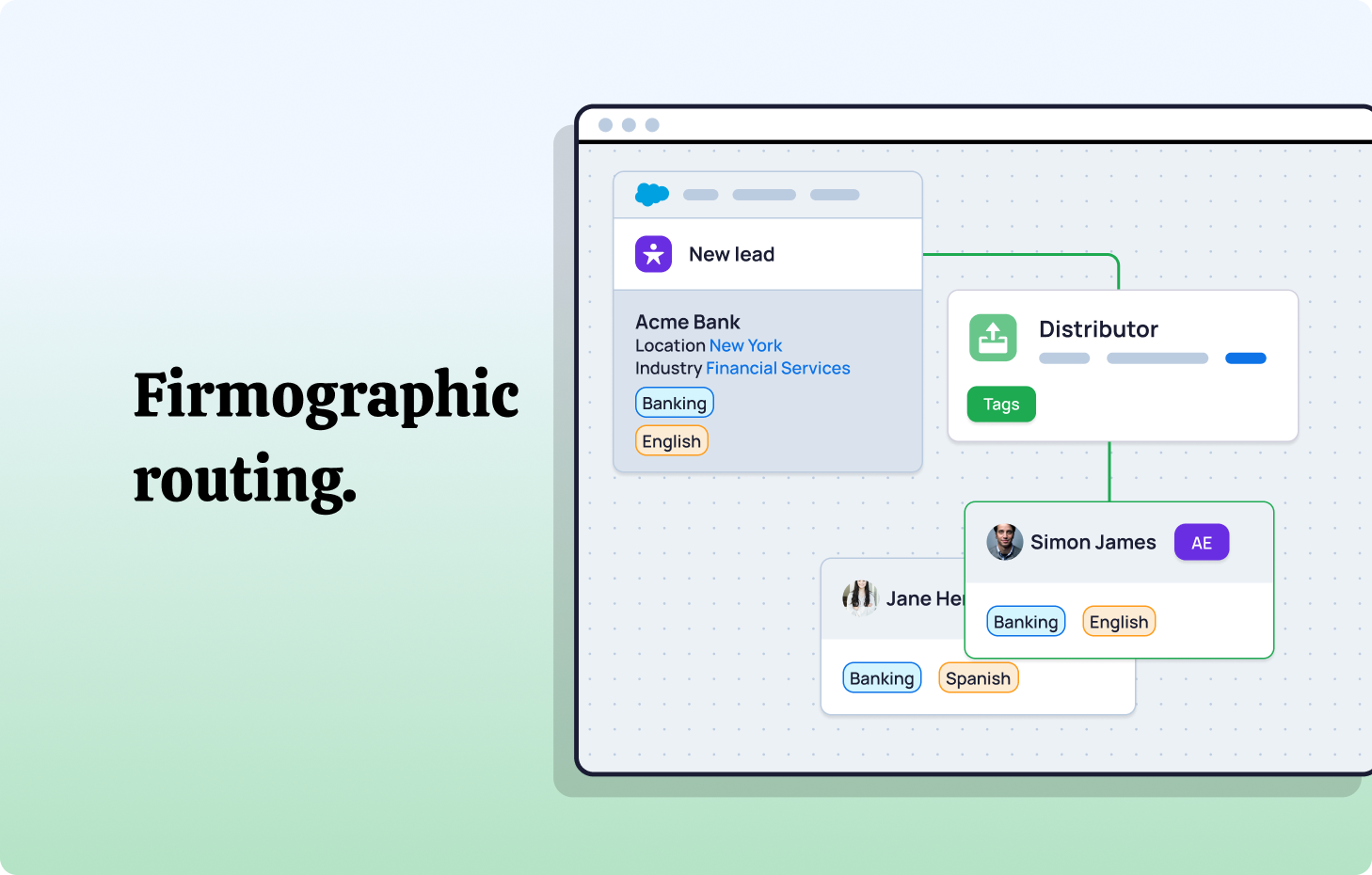
2. Demographic & firmographic scoring.
Demographic and firmographic scoring evaluates leads based on static profile attributes: company size, annual revenue, industry vertical, job title, seniority level, geographic location, and technology stack. These are the firmographic data points used in lead scoring models to determine whether a prospect matches your ideal customer profile before any engagement occurs.
This is all about fit - company size, industry vertical, job title, geography, tech stack.
It shines when you've defined a sharp Ideal Customer Profile. Many of our RevOps customers use Distribution Engine's Custom Classification module to "stamp" priority tiers (P1, P2, P3) on incoming leads based on these exact characteristics - streamlining downstream routing & SLA logic.
Why it's powerful: High engagement from a poor-fit lead rarely converts into revenue.
The limitation is that firmographic scoring alone can’t distinguish between a perfectly-fit company that’s actively evaluating solutions and one that won’t be in-market for another 18 months. That’s why most effective models pair firmographic fit with behavioural signals.
Best suited for: B2B organizations with well-defined ICPs & territory structures.
3. Behavioural (engagement-based) scoring.
Behavioural lead scoring measures how actively a prospect is engaging with your brand by tracking actions such as email opens, webinar attendance, product trial usage, content downloads, pricing page visits, and repeat site sessions. Unlike demographic scoring, which evaluates who the lead is, behavioural scoring evaluates what the lead is doing - and how closely those actions resemble the patterns of leads who have previously converted.
Measures how engaged leads are - tracking email opens, webinar attendance, product trial usage, content consumption.
When combined with speed-to-lead automation, behavioral scoring becomes particularly potent. Take 360 Learning: they achieved 97% routing accuracy & slashed lead response time to under 10 minutes by connecting their engagement scoring with Distribution Engine's workload-based assignment.
Why it resonates:
- Behavior signals buying readiness
- Active leads convert faster with instant routing
Where it stumbles:
- Easy to overvalue vanity engagement metrics
- Requires clean marketing automation data
This is where intent signals improve lead scoring accuracy. A lead who visits your pricing page three times and downloads a competitor comparison guide is demonstrating purchase intent that outweighs demographic fit alone. Modern behavioural models weight these high-intent actions heavily - a single demo request often carries more predictive value than a dozen email opens.
4. Predictive (AI-based) scoring.
Predictive lead scoring uses machine learning algorithms to analyse historical CRM data - including which leads converted and which didn’t - to automatically identify the attributes and behaviours that correlate most strongly with closed deals. Unlike rule-based models where teams manually assign point values, predictive systems continuously learn from new outcomes and adjust scores dynamically, often surfacing conversion patterns that human analysts would miss.
Why teams love it:
- Removes human bias
- Updates dynamically
- Uncovers hidden conversion patterns
But here's the catch: it's only as reliable as your underlying CRM hygiene. Most of our customers share the view that data quality - not algorithm sophistication - is the biggest barrier to trust. Without consistent assignment & ownership practices, predictive models degrade quickly.
Salesforce’s Einstein Lead Scoring is the most common entry point for teams exploring predictive models within the Salesforce ecosystem. It analyses historical conversion data to score leads automatically, but its effectiveness depends entirely on the quality and completeness of the underlying data. Teams with inconsistent field usage or poor lead-to-opportunity attribution often find that Einstein’s scores don’t align with their sales team’s experience - which is why CRM hygiene is a prerequisite, not an afterthought.
Best suited for: Data-mature organizations with disciplined Salesforce processes.
5. Hybrid models.
Hybrid lead scoring models combine firmographic fit with behavioural engagement signals, giving teams a complete picture of both who the lead is and how interested they are. This is the most common approach for B2B SaaS and enterprise sales teams because it balances the objectivity of data-driven automation with the contextual judgment needed to account for market nuances and segment-specific buying patterns.
In practice, Distribution Engine customers like Tebra leverage hybrid models effectively: routing based on rep skills, territory alignment, & capacity - delivering 40% faster response times & 30% higher conversion rates post-merger.
Why it's effective:
- Balances quality & quantity
- Enables dynamic weighting by segment
- Pairs seamlessly with automated routing
Lead Scoring Model Comparison
The following comparison summarises the key differences between the five lead scoring model types, including their data requirements, strengths, limitations, and which business stage each is best suited for.
Rule-based scoring requires only manually defined rules and offers full transparency into how scores are assigned. The main limitation is that it doesn't scale well as lead volume grows, and it won't adapt over time without manual updates. This model works best for early-stage businesses that need a simple, controllable starting point.
Demographic and firmographic scoring draws on CRM profile data to align leads against an ideal customer profile. It's particularly strong for B2B organisations with a well-defined ICP, though it ignores engagement signals entirely. Scores are based on static attributes, so the model doesn't adapt automatically.
Behavioural scoring relies on marketing automation data to capture intent signals like page visits, downloads, and email engagement. It suits high-volume inbound environments where activity patterns reveal buying intent, but carries a risk of inflating scores based on vanity metrics. It adapts partially, as new actions are tracked as they're configured.
Predictive (AI-driven) scoring needs historical CRM data and clean datasets to function effectively. Its key strength is removing human bias and surfacing patterns that manual models miss, though this comes with a black-box risk where scoring logic is harder to interpret. It's best suited to data-mature enterprises and adapts continuously through machine learning.
Hybrid scoring combines fit and engagement data to build the most complete picture of lead quality. The trade-off is a more complex setup and ongoing maintenance, but for businesses scaling from growth stage to enterprise, it offers the most balanced and adaptable approach — provided it's reviewed regularly.
Choosing the right model for your business.
You don't select a lead scoring model because it's trending on LinkedIn. You choose it because it matches your data maturity, sales motion, & team capacity.
{{blog-lead-conversion-kpis="/utility/matrix"}}
Pro tip: If you're not confident in your CRM hygiene or cross-functional handoffs, start simple & add complexity progressively.
The hidden variable: Lead routing.
Even the most sophisticated scoring model falls flat if high-priority leads sit unassigned.
That's where speed-to-lead becomes your revenue multiplier.
A 2024 internal benchmark revealed that Distribution Engine customers who route scored leads within five minutes see 20–40% better conversion rates versus those routing manually.
Why routing matters as much as scoring.
Scoring identifies who deserves attention. Routing ensures who gives it.
The marketing-to-sales handoff is where most lead scoring systems succeed or fail. A perfectly scored lead that sits unassigned for two hours has already lost much of its conversion potential. Research consistently shows that the odds of qualifying a lead drop significantly when response times exceed five minutes - which means your routing logic needs to be as well-designed as your scoring logic.
An effective routing system:
- Delivers high-score leads to the right rep instantly
- Balances territories & workloads intelligently
- Monitors SLA breaches & reassigns automatically
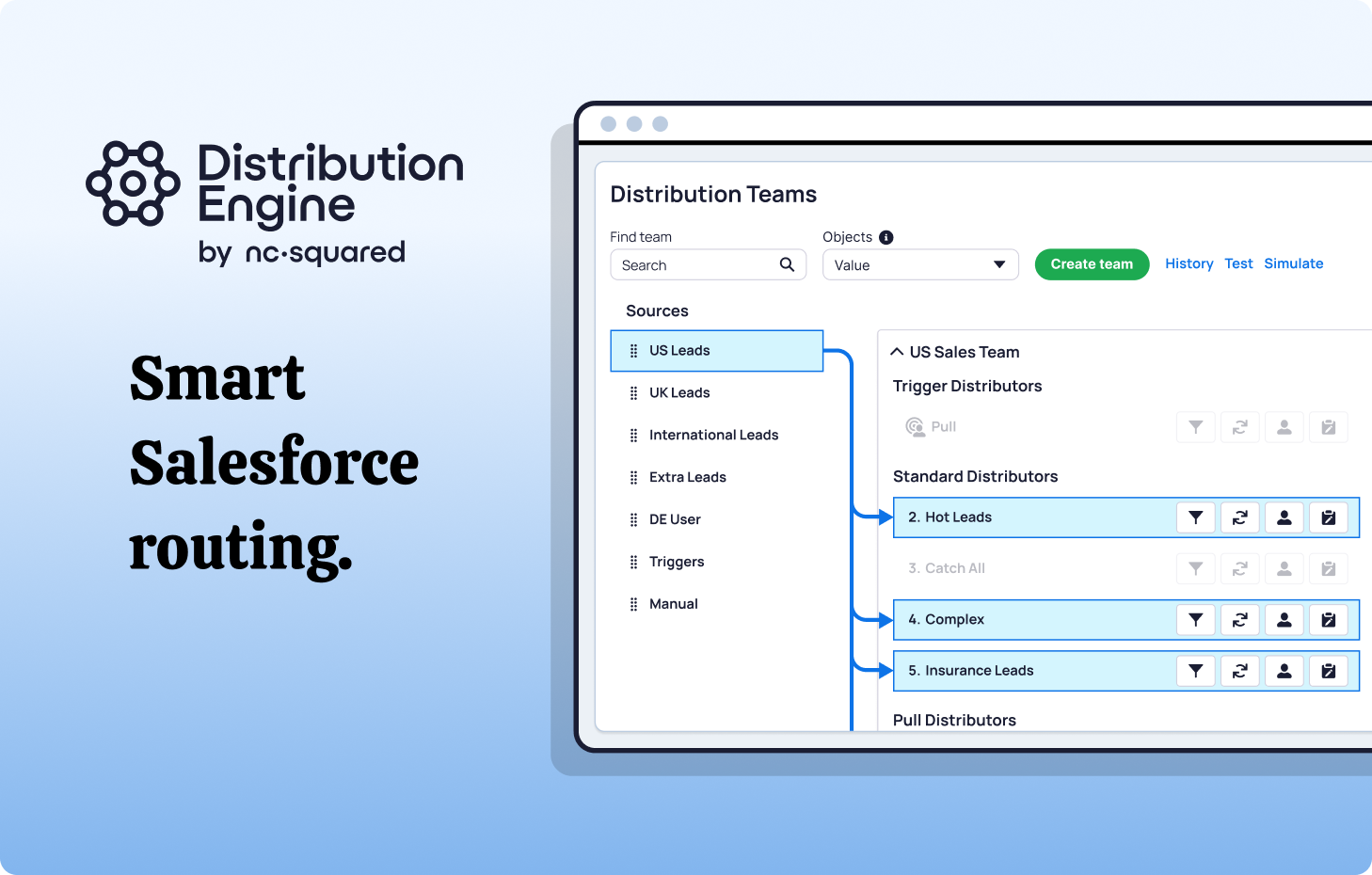
This is where NC Squared's Distribution Engine differentiates itself.
As a 100% Salesforce-native solution, it automates routing across any object - Leads, Cases, Opportunities, even Renewals - while providing real-time performance visibility.
Common pitfalls to dodge.
- Overengineering from day one. Start with five variables, not fifty.
- Ignoring sales feedback. Trust evaporates if reps can't validate the scores they see.
- Treating scoring as "set & forget." Review your logic quarterly at minimum.
- Sticking with manual routing. If you're still distributing leads via email spreadsheets, your speed-to-lead is bleeding out.
Conflating engagement with intent. A lead who opens every marketing email but never visits your pricing page or requests a demo is engaged but not necessarily in-market. Effective models differentiate between passive consumption and active buying signals - and weight them accordingly.
Companies like Aetna experienced this firsthand: before automating case assignments with Distribution Engine, managers burned eight hours daily on manual distribution. Post-implementation, they reclaimed that time & dramatically improved SLA compliance.
Operationalizing lead scoring in Salesforce: A practical framework.
Operationalising lead scoring in Salesforce: A step-by-step framework
Step 1: Define success metrics. Align Sales & Marketing on what “qualified” actually means. Agree on shared MQL and SQL definitions, expected conversion rates by score band, and the SLAs governing how quickly each lead type must be worked.
Step 2: Choose your signals. Blend firmographic fit with behavioural intent. Identify the specific attributes and actions that historically correlate with closed-won deals in your CRM - not the signals that feel important but the ones that actually predict revenue.
Step 3: Assign weights and set thresholds. Use historical deal data to establish rational thresholds. Start with an MQL threshold between 60 and 80 points, and define separate thresholds for SQL handoff if your sales cycle warrants it.
Step 4: Implement in Salesforce. Deploy custom fields for scores. Automate routing via Distribution Engine for instant handoff. Ensure that scoring fields, assignment rules, and SLA timers are all connected so that the moment a lead crosses your threshold, it’s routed to the right rep without manual intervention.
Step 5: Monitor & iterate. Compare closed-won versus closed-lost patterns quarterly. Track conversion rates by score band, average speed-to-lead by assignment method, and the percentage of MQLs that sales accepts versus rejects.
Step 6: Close the feedback loop. Gather rep input & refine scoring rules continuously. Build closed-loop reporting between CRM pipeline stages and score bands so that marketing can see which scores actually produce revenue - and which produce pipeline that stalls.
Real-world impact.
When routing & scoring work in harmony, results compound:
- 360 Learning boosted conversion rates 40% with 97% routing accuracy
- Tebra unified two legacy systems & accelerated follow-up by 40%
- Shutterstock eliminated 60 hours per week of manual case routing
These teams didn't just score leads better - they acted faster.
Final thoughts.
Lead scoring doesn't need to be flawless. It needs to be credible & repeatable.
When paired with intelligent, native routing in Salesforce, it transforms from a spreadsheet exercise into a genuine revenue engine.
If you're ready to make that shift, NC Squared's Distribution Engine helps you:
- Route leads instantly & equitably
- Enforce SLAs automatically
- Keep all logic secure, transparent, & 100% Salesforce-native
Whether you’re evaluating your first scoring model or replacing one that’s lost your team’s trust, the fundamentals remain the same: choose a model that matches your data maturity, connect it to automated routing so scores trigger action, and review quarterly so the system evolves with your market. The teams that treat scoring as a living operational system - not a one-time configuration - are the ones that see sustained improvements in conversion rates, speed-to-lead, and revenue predictability.
Frequently Asked Questions About Lead Scoring Models
What are lead scoring models?
Lead scoring models are structured frameworks that B2B sales and marketing teams use to assign numerical values to prospects based on their demographic attributes, firmographic fit, and behavioural engagement. The model defines which data points are evaluated, how they’re weighted, and at what threshold a lead qualifies for sales handoff. Common types include rule-based, demographic, behavioural, predictive (AI-driven), and hybrid models.
What is the difference between rule-based and predictive lead scoring?
Rule-based lead scoring relies on manually defined point values assigned to specific attributes and actions (e.g. +20 for a demo request, +10 for a target industry). It’s transparent and easy to set up but doesn’t adapt to changing buyer behaviour without manual updates. Predictive lead scoring uses machine learning to analyse historical conversion data and automatically identify the patterns that correlate with closed deals. It adapts dynamically but requires clean CRM data and can feel like a black box if the model’s reasoning isn’t surfaced to reps.
What are the best lead scoring models for B2B SaaS companies?
Most B2B SaaS companies achieve the best results with hybrid lead scoring models that combine firmographic fit (company size, industry, job title) with behavioural engagement signals (pricing page visits, demo requests, content downloads). For early-stage SaaS teams with limited historical data, a rule-based or firmographic model provides a solid starting point. As the dataset matures, layering in predictive or AI-driven scoring improves accuracy and surfaces conversion patterns that manual rules miss.
How do firmographic data points improve lead scoring?
Firmographic data points - including company size, annual revenue, industry vertical, technology stack, geographic location, and number of employees - are used to evaluate whether a lead matches your ideal customer profile before any engagement occurs. By scoring these attributes, teams can filter out poor-fit leads early (regardless of engagement level) and prioritise prospects from companies that historically convert at higher rates. This is particularly valuable for B2B organisations with well-defined ICPs and territory-based sales structures.
How does Einstein Lead Scoring work in Salesforce?
Salesforce’s Einstein Lead Scoring uses machine learning to analyse your historical lead-to-opportunity conversion data and automatically score new leads based on the patterns it identifies. It evaluates fields like job title, industry, company size, lead source, and engagement history, then assigns a score between 1 and 99 indicating conversion likelihood. Einstein updates scores as new data comes in, but its accuracy depends entirely on the quality and completeness of your CRM data - teams with inconsistent field usage or poor lead-to-opportunity attribution often find the scores unreliable.
What is the difference between fit scoring and behavioural scoring?
Fit scoring (also called explicit or demographic scoring) evaluates whether a lead matches your ideal customer profile based on static attributes like job title, company size, industry, and location. Behavioural scoring (also called implicit or engagement scoring) measures what actions a lead has taken - such as visiting your pricing page, attending a webinar, downloading a whitepaper, or requesting a demo. The most effective lead scoring models combine both into a hybrid approach, capturing who the lead is and how interested they are.
How do you choose the right lead scoring model for your business?
Choose your lead scoring model based on three factors: data maturity, sales cycle complexity, and team capacity. If you have limited historical data and a small team, start with a rule-based or firmographic model for transparency and simplicity. If you have moderate data and a growing inbound pipeline, a hybrid model combining fit and engagement signals will scale better. If you have a large, clean CRM dataset with well-tracked conversion history, predictive or AI-driven scoring can surface patterns and automate scoring at a level manual approaches can’t match. The key is to start simple and add complexity as your data justifies it.
Fancy giving Distribution Engine a try?
Have a play around for free, or get in touch if you’d prefer to chat.





Take us for a spin with a 30 day Free Trial
Have a play around for free, or get in touch if you’d prefer to chat.
%20dark.avif)