
Salesforce Ben's AppAssessor review of Distribution Engine - check it out now!
Test it for free for 30 days or get in touch if you’d prefer to chat.
Fancy giving Distribution Engine a try?
Have a play around for free, or get in touch if you’d prefer to chat.
What Is Revenue Operations (RevOps)? The Complete Guide for Salesforce Teams
Key takeaways:
RevOps aligns the whole revenue engine: Revenue operations unifies the people, process, technology, and data behind marketing, sales, and customer success - so the entire go-to-market motion runs as one system instead of three arguing ones.
It exists to kill the silos: RevOps emerged because marketing ops, sales ops, and CS ops each optimizing their own patch produced friction, finger-pointing, and leaky handoffs. One function owning the whole funnel fixes that.
RevOps ≠ sales ops: Sales ops serves the sales team. RevOps serves the revenue - end to end, from first touch to renewal. RevOps is the wider remit; sales ops often sits inside it.
A RevOps framework rests on four pillars: Operations & process, enablement, tools & systems, and insights & analytics. Get all four working together and revenue becomes predictable rather than hopeful.
On Salesforce, RevOps lives or dies in the details: Lead routing, speed-to-lead, fair distribution, and meeting handoff are where strategy meets the platform - the unglamorous machinery that decides whether the funnel actually flows.
The job is to make revenue predictable: RevOps turns go-to-market from reactive firefighting into a measurable, repeatable, forecastable engine - and the best teams treat their own process as a product they continually improve.
That gap - the friction between the revenue teams rather than inside any one of them - is the problem revenue operations was invented to solve.
If you've landed here trying to pin down what RevOps actually is - whether it's a real discipline or just sales ops with a fashionable new name, and what it means for a team running on Salesforce - this guide is the straight answer. We'll define it, explain why it exists, separate it from sales ops, lay out the framework, and get specific about what RevOps looks like on the Salesforce platform.
What is revenue operations (RevOps)?
Revenue operations (RevOps) is the function that aligns the people, processes, technology, and data across marketing, sales, and customer success - so that the entire go-to-market motion operates as a single, accountable revenue engine.
Instead of three separate "ops" teams each serving one department, RevOps takes ownership of the whole revenue lifecycle: how a stranger becomes a lead, a lead becomes an opportunity, an opportunity becomes a customer, and a customer becomes a renewal and an advocate. Its job is to remove friction at every handoff and make the whole thing measurable, repeatable, and predictable.
The short version: RevOps is the operating system for revenue. Marketing, sales, and CS are the applications; RevOps is the layer underneath that makes sure they all run on the same data and don't crash into each other.
Why RevOps exists: the problem it solves.
RevOps didn't appear because someone wanted a new job title. It appeared because the siloed-ops model stopped working as go-to-market got more complex. The symptoms are familiar to anyone who's lived them:
- Leaky handoffs. Marketing passes leads to sales with no shared definition of "qualified," so good leads get ignored and bad ones waste rep time.
- Conflicting metrics. Each team reports success on its own terms, and nobody can answer a simple question like "what's our true cost to acquire a retained customer?"
- Tool sprawl. A pile of disconnected systems, each owned by a different team, none of them talking cleanly to the others.
- Finger-pointing. When revenue misses, marketing blames sales for not working the leads, sales blames marketing for sending junk, and CS blames sales for over-promising. Everyone's partly right, which is the whole problem.
RevOps fixes this by putting one function in charge of the connective tissue - the shared definitions, the clean data, the smooth handoffs, the single source of truth. The result is less internal friction and more revenue making it all the way through the funnel.
RevOps vs sales operations: what's the difference?
This is the question that trips most people up, because the two overlap heavily. The cleanest distinction:
- Sales operations serves the sales team. Its remit is sales productivity - territory and quota planning, pipeline management, forecasting, CRM hygiene, sales tooling. It's deep but narrow.
- Revenue operations serves the revenue - the entire customer journey across marketing, sales, and customer success. It's the broader remit, and in most modern orgs sales ops sits inside RevOps, alongside marketing ops and CS ops, rather than beside it.
A useful way to hold it: sales ops asks "how do we make the sales team more effective?" RevOps asks "how do we make the whole revenue engine more effective?" Same DNA, wider lens. Marketing ops and customer success ops relate to RevOps the same way - specialist functions that RevOps unifies under one strategy and one set of numbers.
The four pillars of a RevOps framework.
Most working RevOps frameworks come down to four pillars. A healthy function is strong in all four; weakness in any one shows up as leaked revenue somewhere downstream.
1. Operations & process.
The design of the revenue workflow itself - lead lifecycle stages, qualification criteria, handoff rules, the lead routing and distribution logic, deal stages, and renewal motions. This is where most day-to-day RevOps work happens: standardizing how revenue actually moves.
2. Enablement.
Making sure the humans can execute the process - onboarding, training, playbooks, content, and the documentation that lets a new rep ramp without a three-week shadowing tour. Process without enablement is just a diagram nobody follows.
3. Tools & systems.
The technology stack and how it fits together - the CRM (Salesforce, for our purposes) as the hub, plus the routing, scheduling, enrichment, and analytics tools around it. The RevOps mandate here is integration over accumulation: fewer tools, cleaner data, no silos.
4. Insights & analytics.
The reporting layer that turns activity into decisions - pipeline analytics, conversion rates, speed-to-lead, forecast accuracy, and the unified metrics that let leadership steer. The old line holds: you can't improve what you don't measure.
What does a revenue operations manager actually do?
A revenue operations manager is the person who owns this in practice. Day to day, the role swings between strategy and the weeds:
- Designing and maintaining the revenue process end to end, and the rules that govern handoffs.
- Owning CRM architecture and data quality so the single source of truth stays single and true.
- Managing the go-to-market tech stack - evaluating, integrating, and retiring tools.
- Building the reporting and forecasting leadership relies on.
- Untangling the cross-team friction that no single department head wants to own.
The best RevOps managers treat their own operation as a product: they ship improvements, measure the impact, and iterate - rather than setting up a process once and letting it ossify.
RevOps on Salesforce: where strategy meets the platform.
For a Salesforce team, RevOps stops being a philosophy and becomes a set of very concrete decisions inside your org. Salesforce is the hub - the single source of truth the whole model depends on - which means the unglamorous operational details are exactly where RevOps strategy succeeds or fails. A few of the highest-leverage ones:
- Lead routing and distribution. How inbound leads reach the right rep - fairly and fast. Get this wrong and your funnel leaks at the very first handoff. (See our guides to automating lead routing and building a fair, fast distribution system.)
- Speed-to-lead. The response-time discipline that decides a huge share of pipeline before a rep speaks. RevOps owns the system that makes fast the default. (Here's why it matters and how to fix it.)
- Meeting handoff and scheduling. Getting qualified prospects onto the right calendar instantly, with context intact - the appointment scheduling layer that turns interest into held meetings.
- Lead scoring and qualification. Shared, data-backed definitions of who's ready, so marketing and sales finally agree. (Our guide to lead scoring in Salesforce goes deeper.)
- Territory management. Clean, maintainable territory logic so ownership is never ambiguous.
Notice the theme: RevOps strategy is only as good as the operational machinery that executes it inside Salesforce. The grand framework lives or dies on whether a lead actually reaches an available rep in five minutes.
How to build (or level up) a RevOps function.
You don't need a 20-person team to start. A practical maturity path:
- Unify the data first. Agree on shared definitions (what's an MQL, an SQL, a closed-won) and make Salesforce the single source of truth. Everything else depends on this.
- Map the revenue process end to end. Whiteboard the journey from first touch to renewal and find the friction at each handoff.
- Fix the worst leak. Usually it's the marketing-to-sales handoff - routing and speed-to-lead. Start where the revenue loss is biggest.
- Consolidate the stack. Audit your tools; integrate or cut. Favor Salesforce-native where you can to avoid sync fragility and data silos.
- Build the reporting layer. Unified dashboards leadership trusts, with the metrics that matter (pipeline, conversion, speed-to-lead, forecast accuracy).
- Iterate on a cadence. Treat the operation as a product. Review, measure, improve - monthly, not annually.
Common RevOps mistakes to avoid.
- Rebranding sales ops and calling it done. Renaming the team without widening the remit to marketing and CS misses the entire point.
- Strategy with no operational teeth. A beautiful framework that ignores the routing, scoring, and scheduling machinery is a slide deck, not a function.
- Tool accumulation. Buying a new app for every problem creates the silos RevOps is supposed to remove. Integrate before you acquire.
- Vanity metrics. Reporting activity instead of outcomes. Measure what moves revenue, not what's easy to count.
- Set-and-forget process. Revenue motions change; a process you never revisit slowly stops matching reality.
How NC Squared fits into your RevOps stack.
RevOps is the strategy; NC Squared builds the operational machinery for the routing and scheduling layer of it - natively in Salesforce, no code required.
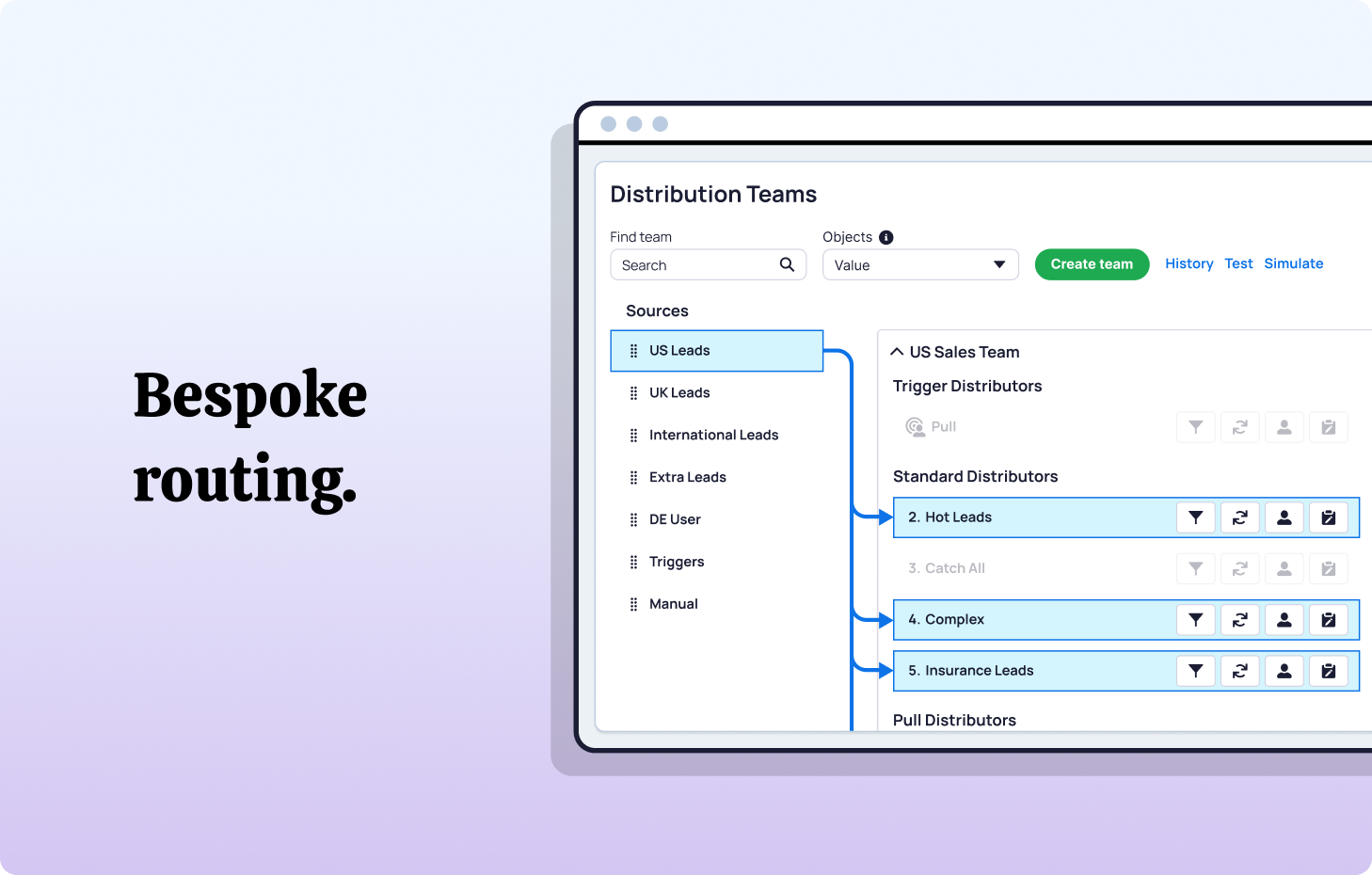
- Distribution Engine handles intelligent, fair, fast assignment of leads, cases, opportunities, accounts, and contacts - the routing and distribution backbone of pillar one, with the audit trails and dashboards pillar four needs.
- Booking Engine handles meeting scheduling and SDR-to-AE handoff, so qualified prospects reach the right calendar instantly.
Both are 100% Salesforce-native, manager-friendly, and built for exactly the moment when out-of-the-box tools and custom code stop cutting it - which is usually the moment a RevOps function starts to mature.
Frequently asked questions.
What is RevOps in simple terms?
RevOps (revenue operations) is the function that aligns marketing, sales, and customer success around one shared process, one tech stack, and one set of data - so the whole go-to-market motion runs as a single revenue engine instead of three disconnected teams. Think of it as the operating system for revenue.
What's the difference between RevOps and sales ops?
Sales ops serves the sales team and focuses on sales productivity (territories, quotas, forecasting, CRM hygiene). RevOps serves the entire revenue lifecycle across marketing, sales, and customer success. RevOps is the broader function, and sales ops usually sits inside it.
Is RevOps just a rebrand of sales operations?
No - though it's sometimes implemented that way. The defining difference is scope: true RevOps unifies marketing ops, sales ops, and customer success ops under one strategy and one set of metrics. Simply renaming the sales ops team without widening the remit misses the point.
What does a revenue operations manager do?
A RevOps manager owns the revenue process end to end - designing workflows and handoff rules, maintaining CRM architecture and data quality, managing the go-to-market tech stack, building forecasting and reporting, and resolving the cross-team friction that no single department owns.
What is a RevOps framework?
A common RevOps framework rests on four pillars: operations & process, enablement, tools & systems, and insights & analytics. A healthy RevOps function is strong across all four; weakness in any one tends to show up as leaked revenue downstream.
The bottom line: RevOps makes revenue a system, not a scramble.
Revenue operations is what you get when you stop treating marketing, sales, and customer success as separate machines and start running them as one. Define the process, unify the data, integrate the stack, measure relentlessly, and the funnel stops leaking at the seams.
But strategy only earns its keep when the machinery underneath it works - when a lead actually reaches an available rep in minutes and the meeting actually lands on the right calendar. That's the layer where RevOps becomes real, and it's the layer we build.
Get the operating system right, and revenue stops being a quarterly scramble and starts being something you can actually predict.
Fancy giving Distribution Engine a try?
Have a play around for free, or get in touch if you'd prefer to chat.
Fancy giving Distribution Engine a try?
Have a play around for free, or get in touch if you’d prefer to chat.





Take us for a spin with a 30 day Free Trial
Have a play around for free, or get in touch if you’d prefer to chat.
%20dark.avif)